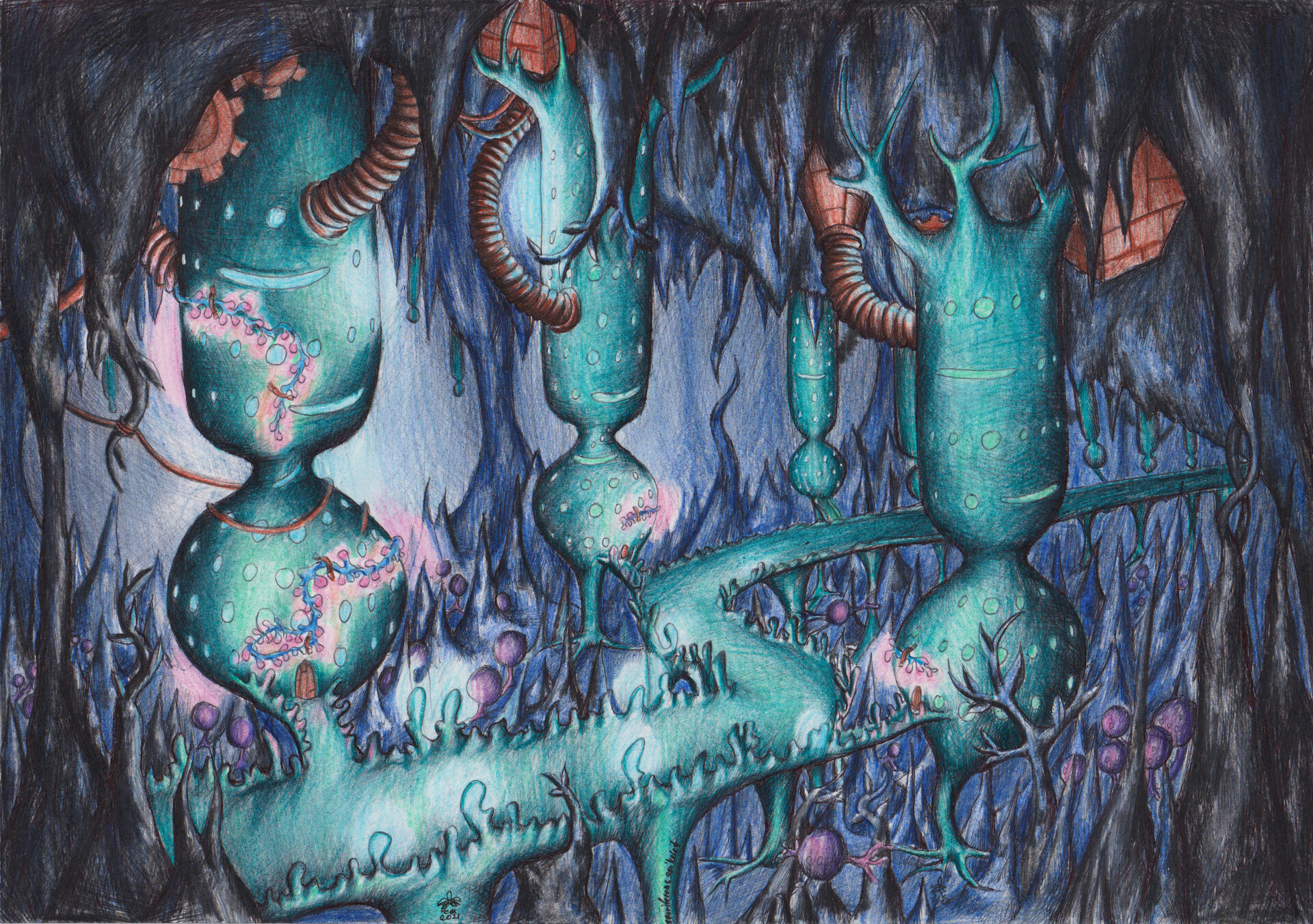
Underground cell city
These are the concepts of the houses of the underworld. The cells of the retina are taken as a basis (the diagram that inspired, at the end).
Biologically, these houses are multicellular organisms that simultaneously resemble fungi and protozoa (protozoa are unicellular or colonial organisms containing a nucleus, the most famous of which are ciliates and amoeba). They are distinguished from mushrooms by the absence of mycelium, and from the simplest by their multicellularity. Houses are grown, go through a life cycle and die, but their structure remains.
The illumination is mainly provided by the bioluminescence of some algal-like organisms. Ventilation, heating and sometimes light are provided by mechanisms built into the ceiling of the cave complexes. The pipes come to the surface. Therefore, underground cities are easy to spot from outside: smoke and steam pillars out of the ground.